The benefits of coloring mandalas for adults
A mandala page in an adult coloring book is usually one big circle printed on a single side of the sheet, a small center with rings of petals or arcs repeating out toward the edge, and you work through it a ring at a time with whatever pencils you have in the tin. What people tend to get from it is fairly modest: half an hour away from the phone, and often feeling a little calmer afterward. Curry and Kasser (2005), and later van der Vennet and Serice (2012), found students' short-term anxiety dropped after coloring mandalas (Curry & Kasser, 2005; van der Vennet & Serice, 2012), although a 2022 review of the trials found free drawing worked about as well (Jakobsson Støre & Jakobsson, 2022).
What is a mandala, and why is it easy to color?
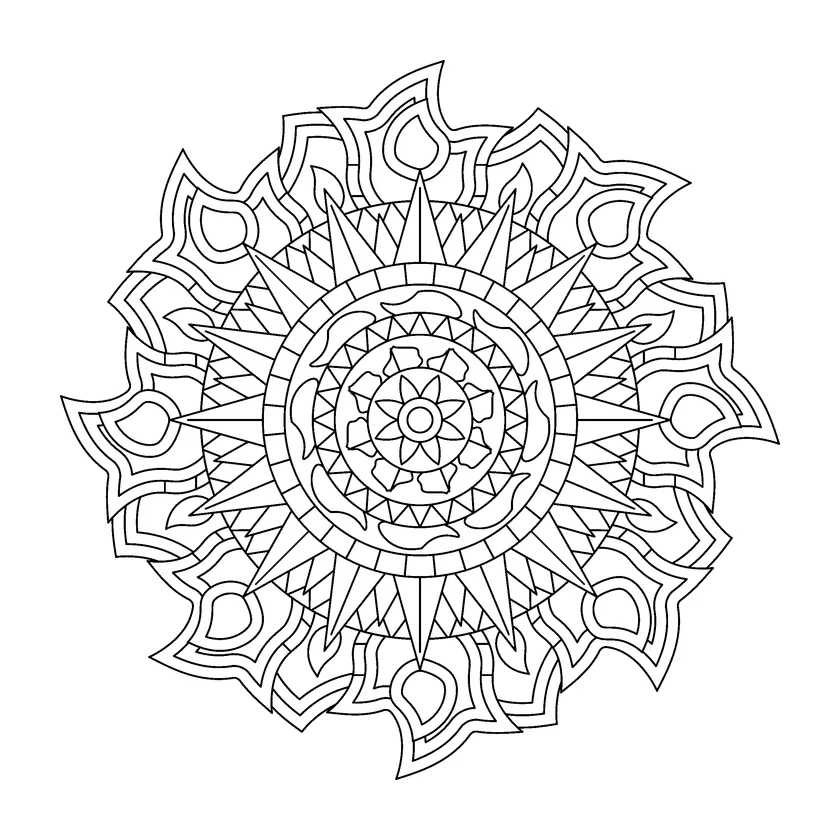
"Mandala" is Sanskrit for circle. In Hindu and Buddhist practice a mandala is a sacred diagram, and plenty of other traditions built their own round, radiating designs. Think of a cathedral rose window, or a Lone Star quilt. The mandalas in coloring books borrow only the geometry, a center with rings of petals repeating outward.
They're easy because they repeat. On a blank sheet you have to decide everything, whereas on a mandala the first real question is what color the inner ring of petals should be, and once that's settled the next several minutes are planned out for you. People who say they can't draw usually find a mandala a comfortable first page for that reason.
What benefits does the research support?
Mostly state anxiety, which is how keyed up someone feels at that moment; none of these studies looked at months or years.
In the 2005 study students wrote about a frightening memory first, then colored. The mandala group came out less anxious than the free-drawing group, and the 2012 replication matched that.
Ashlock and colleagues (2018) gave 160 undergraduates one of four coloring tasks, adult coloring book pages and pre-printed mandalas among them. Anxiety fell in all four groups by about the same amount (Ashlock et al., 2018).
In practice that session is very plain. A printed mandala, three pencils (say a dusty teal, a pale gold and a brick red), and a kitchen timer at twenty minutes. You fill the center circle, then every petal in the first ring teal, then the next ring gold, and the pattern does the planning for you. We went through those studies in more depth, limits included, in does coloring help with stress and anxiety?
One more study is worth knowing about. Girija Kaimal's team compared coloring with a session led by an art therapist. Both lowered stress and bad mood. Only the therapist session lifted positive mood and people's confidence in their own creativity (Kaimal et al., 2017), so a coloring book shouldn't be confused with art therapy.
The everyday benefits people notice
A few of the reasons people give for coloring haven't been studied at all, and they're fairly ordinary.
One is the phone. Thirty minutes with a pencil tin is thirty minutes of not scrolling, and for a lot of people that changes how the whole evening feels. It's partly why the UK charity Mind lists mindful coloring among its everyday mindfulness exercises.
Coloring also holds your attention without being difficult. After ten minutes or so on the rings of a mandala most people settle into a steady back-and-forth stroke, petal after petal, with nothing in particular to work out.
And there's the color. You can try combinations with no pressure to make art, and if one that looked great in your head goes muddy on paper, it's one page. Over a few weeks you learn things like which blues sit well against which greens, and your finished pages start looking more like yours.
Some people like having a finished page at the end of the week to put on the fridge or slip into a folder.
How do you color a mandala?
There's no correct starting point. Many people work from the center out, which lets the design open up like a flower, and you can shift colors bit by bit as you move toward the rim. Others start at the outer edge and work in, which builds a frame first and pulls your eye toward the middle. Try a page each way and see which you prefer.
Three to five colors picked at the start is usually plenty for one page. If you want a theme, borrow it from the design. Our Elemental Mandalas are grouped by element, so Water pages suit blues and sea greens and Fire pages take ambers and deep reds well. You're free to ignore that.
It helps to color the matching petals in each quarter one after another. Then if your hand slips over a line on one of them, you can let the same slip happen on the others and it looks deliberate. Pencils go on in two light coats, and any color you plan to layer is worth trying on the test page first, because yellow on top of purple, for example, goes a muddy brown. Markers are fine too on single-sided pages, since the ink comes through the back of the sheet.
Which mandala designs should beginners choose?
Check the outlines first. You want lines that are crisp and the same weight all over the page, plus a mix of big shapes and small ones. Pages made entirely of tiny cells look good in photos but are hard work after a long day, and a bigger page gives your wrist somewhere to rest.
Each book in the Nocetta Mandala Collection has 48 original designs on single-sided 8.5 × 11 in pages, plus a color-test page. Elemental Mandalas is on Amazon now. Skyward (sun, moon and stars), Meadowbloom (florals) and Frostlight (winter) are on the way, and you can already buy all four as $5.99 printables or get the four-book printable bundle for $14.99. The free sampler has four Elemental pages if you'd like to try before buying.
Elemental Mandalas
48 mandalas of water, earth, air and fire. Paperback on Amazon, or a $5.99 printable.
See the book