Does coloring help with stress and anxiety?
For some adults it seems to, at least in the short term, and a handful of small trials back that up. Coloring isn't a treatment for an anxiety disorder, though, and the studies we have are small and brief, with mostly university students as volunteers. If you like coloring and feel calmer afterward, keep doing it. If anxiety is running your days, coloring can sit next to proper support but shouldn't replace it.
What did the studies actually find?
Flett and colleagues in New Zealand (2017) had 104 female university students either color every day for a week or do logic puzzles. The coloring group reported fewer depression and anxiety symptoms afterward; the puzzle group didn't change much (Flett et al., 2017). The authors called it preliminary.
Rajendran and colleagues (2020) handed anxious patients in an Australian emergency department either a coloring pack or a placebo pack, and anxiety fell more in the coloring group over two hours (Rajendran et al., 2020). That was 53 patients.
Trying something like that week at home doesn't take much setting up. Leave a printed page and a few pencils on the table where you eat, so they're in the way, and set a kitchen timer for twenty minutes, which is about what the shorter studies used. On the first evening you might get the center of a mandala done and part of the first ring, on the second a bit more, and by the end of the week most of the page, or not, since nobody in these studies was graded on finishing.
Eaton and Tieber (2017) had 85 undergraduates either pick their own colors or copy a pre-colored version; both groups felt less anxious, the free-choice group slightly more so (Eaton & Tieber, 2017). Ashlock and colleagues (2018) tried four coloring activities on 160 students and all four lowered anxiety about equally (Ashlock et al., 2018).
Kaimal and colleagues (2016) measured cortisol, a stress-linked hormone, in 39 healthy adults before and after 45 minutes of free art-making, and it dropped (Kaimal et al., 2016). No coloring books, no comparison group.
Where does the evidence stop?
Fairly early on. In nearly every one of these studies people filled in a questionnaire straight after coloring, and the New Zealand trial's single week is as long as anyone was followed. The volunteers were mostly university students, often fewer than a hundred of them. Jakobsson Støre and Jakobsson (2022) pooled the mandala trials and noticed the smallest ones reported the biggest effects (Jakobsson Støre & Jakobsson, 2022), a pattern that usually shrinks as larger studies come in. Whether coloring does anything for an anxiety disorder, or for stress over months, hasn't been tested.
Fancourt and colleagues (2021), writing in The Lancet Psychiatry, listed more than 600 possible routes by which leisure activities might affect health, psychological, biological, social and behavioural (Fancourt et al., 2021). Coloring plausibly touches several of those at once, the screen-free time, the handwork and the small sense of making something.
Why might coloring feel calming?
Your hands are busy and your eyes are fixed on a patch of paper the size of a coin, so there's less room for the same worried thought to go round again. You always know the next step. And coloring forgives tiredness in a way a crossword doesn't, since a slightly wrong color costs you nothing.
For some people it's the repetition. Coloring the same petal six times around a mandala has a rhythm, a little like knitting a row. Other people mostly enjoy color, the small pleasure of putting a rust orange next to a teal and seeing that it works.
Why does coloring give some people anxiety?
This shows up in search more often than you'd expect, and it's a reasonable thing to wonder. Usually the problem is that coloring has turned into a performance. Maybe you're comparing your page with flawless examples on Instagram. Maybe you feel you have to finish a design in one sitting, or going over a line ruins it for you. Then the page starts to feel like homework.
Printing a simpler page with bigger spaces on cheap copy paper, where going over a line only wastes a sheet, takes some of that pressure off, though if it still feels tense after a few evenings it may just not be your hobby.
How can you use coloring for stress?
The studies hint at a rough template. Sessions of about 20 minutes were enough to shift mood, and coloring daily for a week was enough in the New Zealand trial. So twenty minutes on a weeknight is closer to what was tested than a three-hour Sunday session.
Put it in the tense part of your day, the hour after work or the stretch before bed. The page and pencils go on the side table by the chair, the phone goes on the charger in the kitchen. For a slower, more attentive version there's the piece on coloring as a form of meditation.
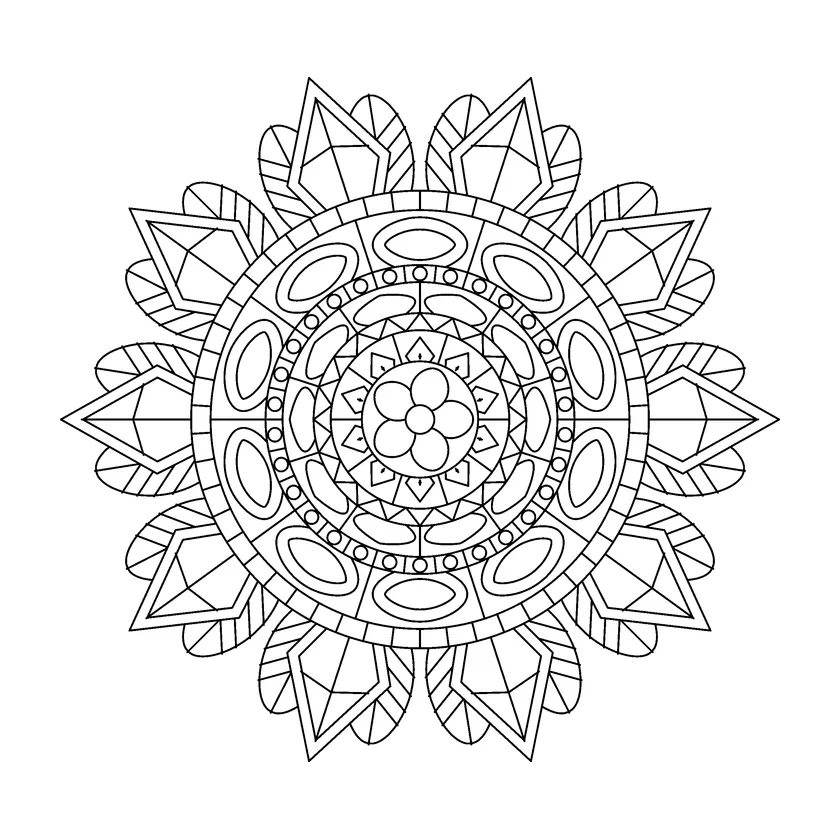
Symmetrical designs with bold outlines are a gentle place to start. The free Nocetta sampler has four mandala pages you can print as often as you like, and each book in the Nocetta Mandala Collection has 48 designs.
Elemental Mandalas
48 mandalas of water, earth, air and fire. Paperback on Amazon, or a $5.99 printable.
See the book