Is coloring a form of meditation?
Not in the strict sense. Meditation is usually a set practice, like sitting and following your breath, and coloring is a hobby. But the two overlap more than you'd think, and if you sit down with a mandala meaning to pay attention, coloring can do a lot of what a short meditation does. One detail from the research is worth knowing up front. When Michail Mantzios and Kyriaki Giannou had students color mandalas with no instructions, their mindfulness scores didn't budge. A second group colored while someone guided them the way a meditation teacher would, and that group's anxiety fell further (Mantzios & Giannou, 2018). So it seems to come down to how you color more than what you color.
What does meditation actually ask of you?
Strip away the cushions and apps and most mindfulness teaching asks for one thing. Pick something to notice, usually your breathing. Your mind will wander off within a minute or so (everyone's does). When you catch it wandering, you bring it back, and you try not to be annoyed with yourself about it.
The UK mental health charity Mind includes coloring in its list of everyday mindfulness exercises. Its suggestion is to focus on "the colours and the sensation of your pencil against the paper" and not worry about drawing anything in particular (Mind).
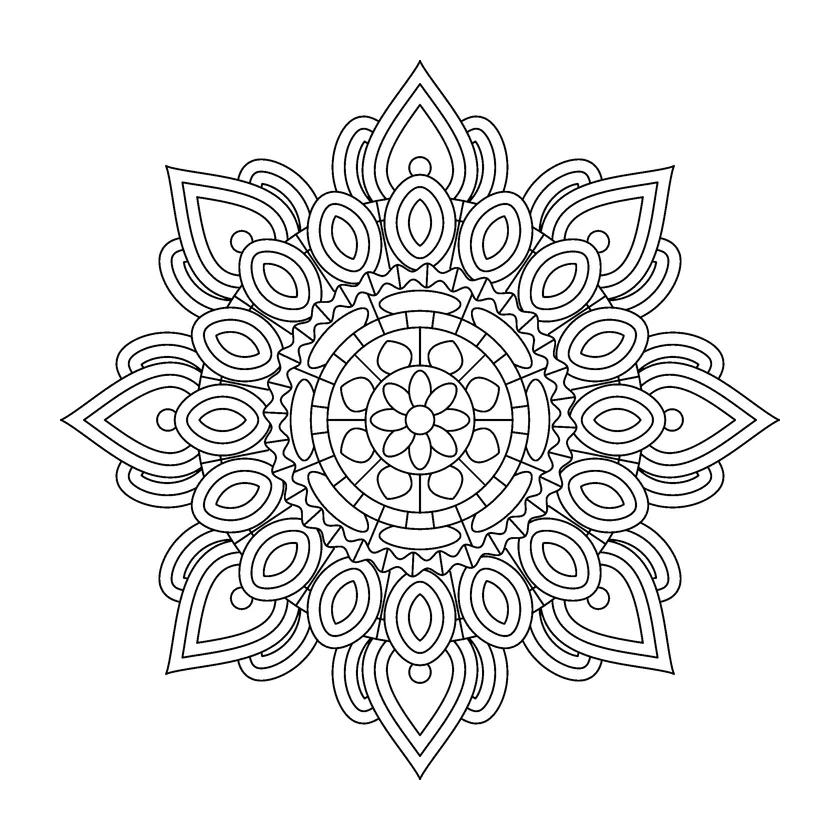
On a mandala page that might look like this: one pencil, a mid blue, sharpened before you start. You fill the first petal from the tip toward the center with light pressure so the paper grain shows, and you listen to the pencil, which scratches on cheap copy paper and goes nearly silent on smooth cardstock. Then the next petal, the same way. With a show on in the background you'd still get a colored page, just less of the noticing.
What did the studies find?
A lot of the popular claims about mandalas trace back to one 2005 experiment. Nancy Curry and Tim Kasser asked students to write about something frightening, which reliably makes people tense. Then the students either colored a mandala, colored a plaid grid or drew whatever they liked on blank paper. Anxiety dropped most in the mandala and plaid groups (Curry & Kasser, 2005). When another team repeated the study in 2012, mandalas helped again, but plaid didn't (van der Vennet & Serice, 2012).
The 2022 meta-analysis is less exciting. Eight trials, 578 adults, mandalas versus free drawing: no significant difference, and the smallest trials had the biggest effects (Jakobsson Støre & Jakobsson, 2022).
So the circle probably isn't special. Twenty minutes with pencils is the part that seems to count.
Mantzios's group has kept at the meditation question with student volunteers. In a 2021 study, students who colored with loving-kindness intentions ended up with about the same short-term mindfulness and anxiety scores as students who did a loving-kindness meditation (Mantzios et al., 2021). In 2019 they had people color on paper or in a phone app, and anxiety fell after one session either way (Mantzios et al., 2019). Keep the scale in mind, though. These were single sessions with university students. They say something about a quieter half hour and very little about anyone's long-term mental health.
How do you color as a meditation?
Any page will do, but repeating designs make it easier, which is one thing mandalas really are good for. Pick a color for the first ring of petals and the next eight petals are already decided. Your hand keeps moving and your head has less to do.
Set a length before starting; twenty minutes is plenty the first time. Put the phone in a different room. Face down on the table isn't far enough, because the buzz still drags your attention over. It also helps to pull three or four pencils out of the tin ahead of time, so you aren't rummaging every few minutes.
Color slower than you normally would, maybe one stroke per out-breath, or just keep your attention on how the pencil drags. Within a few minutes your mind will be off planning tomorrow's errands. When you notice, go back to the petal you were on. That noticing and returning is most of what meditation teachers mean by practice. Over a line? Leave it.
When the timer goes, stop, even mid-ring. Look at the page for a few seconds before you close the book. Leaving a half-colored mandala on the kitchen table makes it more likely you'll sit back down tomorrow.
Is coloring easier than sitting meditation?
It is for many people, especially anyone who fidgets through a five-minute breathing exercise. With coloring your hands are busy, your eyes have a small patch of paper to look at, and twenty minutes later there's something to show for it. The researchers above think coloring might suit people who struggle to start a formal practice. They're also blunt that calling every coloring book "mindful" goes beyond what the studies show.
There's far more research on sitting meditation, including whole structured courses. Coloring isn't a substitute for that, and it isn't a treatment for depression or an anxiety disorder. We think of it as a smaller practice that sits alongside meditation.
Which pages work best for a meditative session?
Look for symmetry and clean, even outlines. Pages packed with tiny cells look impressive in photos, but at 10pm they mostly give you a headache. A mix of big and small spaces is easier on the eyes. We drew our Elemental Mandalas with that in mind: twelve designs for each of water, earth, air and fire, printed single-sided so marker ink doesn't spoil the page behind. You can get it as a paperback on Amazon or as a $5.99 printable. To try the practice first, the free sampler has one page from each element.
Questions people ask
How long should I color to feel calmer?
Nobody has pinned down an ideal length. Most experiments used a single session of about 20 minutes, and one had people color every day for a week (Flett et al., 2017). Twenty minutes is a reasonable place to start.
Can coloring replace therapy or medication?
No. It may take the edge off an evening, and the evidence doesn't go further than that.
Elemental Mandalas
48 mandalas of water, earth, air and fire. Paperback on Amazon, or a $5.99 printable.
See the book